Spend a further £18.00 for free delivery
Free delivery on orders over £18. Shop Now.
Free delivery on orders over £18
Altitude matters because cooler temperatures higher up slow the ripening of coffee cherries. Slower ripening gives denser beans with more sugars and acids, which usually means brighter acidity, more complex flavour and a sweeter cup. That’s why many producing countries grade coffee by altitude, with “strictly hard bean” (SHB) at the top. But altitude is one factor among many, and plenty of great coffee grows lower down.
Arabica likes it cool. It does best at a mean annual temperature of around 19°C, according to research from Kew and CIRAD. In the tropics, the way to find that kind of temperature is to go uphill. Typical arabica farms sit between about 900 and 2,000 metres, and some go higher still.
Higher farms tend to offer:
The most important effect is time. In cooler air the cherries ripen more slowly, which gives the seeds inside longer to build up sugars, acids and aromatic compounds.
Beans that develop slowly are harder and denser. That isn’t folklore. A 2022 study of arabica on Mount Gorongosa in Mozambique, published in Agronomy, found that farms at 935 metres had a fruit maturation period about four weeks longer than farms at 650 metres. The higher beans were larger, more uniform and denser, with chemical changes the authors linked to better cup quality.
Density matters to roasters as well. Dense beans handle heat well and can be roasted to bring out sweetness and acidity without tasting baked. Denser green coffee also tends to hold its quality better in storage before roasting.
High-grown coffees are known for lively acidity, with tasting notes that run from citrus and berries to florals and wine-like tones. When it’s balanced with sweetness, that acidity is what makes a coffee taste vivid rather than flat. If the word acidity puts you off, our guide to coffee acidity explains why it’s a good thing.
Lower-grown coffees, by contrast, tend to be softer, with more body, chocolate and nut flavours and less sparkle. Neither is right or wrong; it depends what you like.
Because altitude and density go together, several Central American countries grade coffee by the height at which it was grown. The names describe the bean: hard bean, and strictly hard bean for the highest. Some countries use “strictly high grown” (SHG) for the same idea.
| Grade | Meaning | Typical altitude |
|---|---|---|
| SHB (strictly hard bean) | The highest-grown, densest beans | Above about 1,350 to 1,400m in Guatemala; above about 1,200m in Costa Rica |
| HB (hard bean) | Grown fairly high | About 1,200 to 1,350m in Guatemala |
| Lower grades | Softer beans from lower farms | Below about 1,200m |
Thresholds vary by country and source (this Q grader study guide sets out the usual bands). Guatemala’s original 1928 system had nine altitude categories, topped by “fancy strictly hard” for coffee grown above about 1,524 metres, and today SHB accounts for the large majority of its exports, according to Barista Hustle.
One thing SHB doesn’t tell you is how good the coffee tastes. It describes where the coffee grew, not how it was picked, processed or roasted. You will often see it on sacks alongside “EP” (European preparation), which refers to sorting standards.
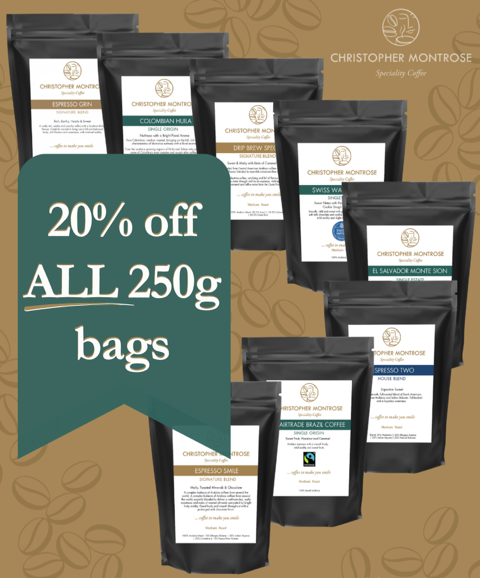
Our Colombian Huila comes from smallholder lots in the mountains of southern Colombia, where coffee is grown at roughly 1,400 to 2,000 metres (Caravela). The cup is full, rich and deep but delicate, a good example of what height brings.
Guatemala, home of the SHB grade, is part of our Espresso Grin blend, alongside Brazil, Colombia and Sumatra.
Jamaica Blue Mountain is another famous example. It comes from the Blue Mountains, which rise to 2,256 metres, and is regulated by the Jamaica Agricultural Commodities Regulatory Authority. Coffee grown lower on the island is sold under other names, such as Jamaica High Mountain (background here). Blue Mountain is smooth and mild, with nutty, chocolatey notes. Our Drip Brew Special was blended to resemble it without the price tag, and we explain how in the best Jamaican Blue Mountain alternative.
It would be easy to conclude that higher is always better. It isn’t.
Latitude changes the numbers. The further a farm is from the equator, the cooler it’s at any given height. A farm at 1,000 metres well south of the equator can have similar temperatures to one much higher in Central America. Altitude figures only make sense alongside where in the world the farm is.
Brazil proves the point. Many Brazilian farms are lower than the SHB farms of Central America, and Brazil is famous for natural process coffees, dried in the cherry, that are sweet, nutty, chocolatey and full bodied. Our Fairtrade Brazil, from the COOCAFE cooperative in Minas Gerais, is a natural: clean, mild and sweet with medium body. Our Swiss Water Decaf comes from the Cerrado in Minas Gerais too. Neither is a high-altitude coffee in Central American terms, and both taste great.
Everything else still counts. Variety, soil, shade, careful picking of ripe cherries, processing, drying and roasting can lift a mid-altitude coffee above a careless high-grown one. Altitude gives a coffee potential; people decide whether it reaches it.
Too high has its problems. Very high farms risk frost, grow more slowly and yield less, and they are harder to work and harder to get coffee out of. As the climate warms, though, higher land is becoming more important, a subject we cover in making the coffee industry more sustainable.
For arabica in the tropics, roughly 1,200 to 2,000 metres produces many of the most prized coffees. Closer to the edges of the coffee belt, lower farms can do just as well.
No. Caffeine depends mainly on species. Robusta, which grows lower and hotter, has about twice the caffeine of arabica.
No. Supremo is a Colombian grade based on bean size, not altitude. Large beans often come from good farms, but size alone doesn’t guarantee flavour.
Colombia, Guatemala, Costa Rica, Ethiopia and Jamaica all welcome visitors to mountain farms. Our article on coffee tourism has ideas.
To taste altitude for yourself, brew the Colombian Huila next to the Fairtrade Brazil. The South American starter kit puts both in one box.