Spend a further £18.00 for free delivery
Free delivery on orders over £18. Shop Now.
Free delivery on orders over £18
Filter coffee is popular because it’s easy to make well, it produces a clean, sweet cup that shows off the flavour of the beans, and it’s happy to be made in quantity. Hot water passes through ground coffee and a filter (usually paper), which holds back the fine particles and most of the oils. The result is lighter in body than espresso or cafetière coffee, with more clarity, and you only need a kettle, a filter and some decent coffee to get started.
This guide covers why filter has come back into fashion, the main ways to brew it, and the numbers that matter: ratio, grind, water temperature and time.
Filter coffee is defined by its brewing method rather than the bean. Ground coffee sits in a filter, hot water is poured over it (by hand or by a machine), and gravity draws the brewed coffee through into a cup or jug below. The extraction is slower and gentler than espresso, which is forced through a puck of fine coffee under pressure in about 30 seconds.
Paper filters trap the finest particles and most of the coffee oils. Metal and cloth filters let more through, so they give a heavier cup that sits somewhere between paper filter and cafetière.
Filter coffee tastes clean. With fewer oils and fines in the cup, you can pick out what makes one coffee different from another: the fruit in a Colombian, the chocolate and nut of a Brazilian. Its acidity tends to come across as softer and more rounded than in an espresso, where the flavours are concentrated and the acidity can be much more pronounced. That makes filter easy to drink, but there’s still plenty going on if you want to pay attention.
A filter machine or a large pour over will make a litre as easily as a mug. You can brew a jug for the whole household, or for a meeting, without standing at an espresso machine making shot after shot. Filter coffee can also be brewed in advance and held, which is why batch brew has always been a mainstay of cafés, offices and hotels. Speed of service matters, and a flask of good filter is very hard to beat for that.
Kit is cheap, too. A plastic dripper and a pack of papers will make excellent coffee, and an electric machine is a fraction of the price of a decent home espresso set-up.
Walk into most independent coffee shops now and you will see a pour over bar or a batch brewer alongside the espresso machine. Speciality roasters like filter because it lets single origin coffees speak for themselves, and baristas have spent the last fifteen years or so refining recipes for drippers such as the V60 and Kalita Wave. In the US, the National Coffee Association’s surveys consistently find the drip coffee maker is the most popular way to brew at home (Daily Coffee News, 2024).
Mug for mug, filter coffee usually carries more caffeine than a single espresso, simply because you drink more of it. Figures used by the European Food Safety Authority put a 200 ml cup of filter coffee at about 90 mg of caffeine and a 60 ml espresso at about 80 mg (EUFIC, citing EFSA 2015). Espresso is far stronger per millilitre; there’s just less of it.
The method of brewing filter coffee as we know it largely traces back to Germany. In 1908 Melitta Bentz, a housewife in Dresden, patented a paper filter system for coffee, and the company that bears her name still makes filters today. Electric drip machines followed later in the century and became standard in American homes and offices.
Germany and the Nordic countries have long preferred a milder, longer cup, and filter suits that style perfectly. The speciality coffee movement then took filter in another direction, towards lighter roasts and precise hand-brewed recipes, which is a big part of why it’s fashionable again.
All of these methods use the same basic principle. The differences are in how much control you have, how much coffee they make and what kind of filter they use.
| Method | Best for | Grind | Typical brew time | Cup character |
|---|---|---|---|---|
| Filter machine | Convenience, several cups | Medium | 4 to 6 minutes | Balanced, consistent |
| V60 | One or two cups, control | Medium-fine | 2.5 to 3.5 minutes | Bright, very clean |
| Chemex | Two to four cups | Medium-coarse | 4 to 4.5 minutes | Very clean, light body |
| Kalita Wave | One or two cups, forgiving | Medium | 3 to 3.5 minutes | Sweet, even |
| Batch brewer | Offices, cafés, gatherings | Medium | 5 to 7 minutes | Balanced, easy to hold |
| Aeropress | Travel, single cups | Medium-fine | 2 to 3 minutes | Fuller, flexible |
The simplest option. Fill the reservoir, put the coffee in the basket, press the button. A good machine heats water to the right temperature and showers it evenly over the bed of coffee. A cheap one may run too cool or dribble water into one spot, which gives a flat or uneven cup. If you’re buying a machine, look for one that has been certified by the Specialty Coffee Association, as these are tested for temperature and brew time.
Pour over means pouring the water by hand, ideally from a gooseneck kettle so you can control the flow. The V60 has a cone shape with a single large hole, so how you pour has a big effect on the result. The Chemex uses thick paper filters that give an exceptionally clean cup. The Kalita Wave has a flat bottom and three small holes, which makes it more forgiving if your pouring is a bit erratic. We compare hand pouring with machines in more detail in pour over v drip brew: which method is best?
Batch brew is the café version of a filter machine: a larger brewer that makes one to three litres at a time into a jug or insulated urn. It’s the reason you can get a good filter coffee in under a minute in many speciality cafés. Brewed coffee is best within about 30 to 60 minutes; after that it starts to taste stewed, especially if it’s kept on a hotplate.
Strictly speaking the Aeropress is an immersion brewer with a paper filter, and you use gentle pressure rather than gravity. It still belongs here, as it makes a clean, filter-style cup and is almost indestructible, which is why it lives in so many camping bags.
A good starting point is 60 g of coffee per litre of water, or 15 g for a 250 ml mug. The Specialty Coffee Association’s Golden Cup guidance is 55 g per litre, give or take 10% (SCA Golden Cup summary), so anywhere from 55 to 65 g per litre is sensible. Weigh both coffee and water if you can. Kitchen scales are the single most useful upgrade for filter coffee, and they cost less than a bag of beans.
If your coffee tastes weak, use more coffee. If it tastes strong but pleasant, add a splash of hot water to the cup rather than changing the recipe.
For most filter methods, aim for a medium grind, a little like coarse sand. Go finer for small single-cup drippers and coarser for a Chemex or large batches. Grind controls how fast the water flows and how much flavour it pulls out:
Freshly ground beans make a noticeable difference. If you don’t have a grinder, buy coffee ground for filter rather than for espresso, which is too fine and will clog the paper. Our guide to grinding coffee at home goes into burr grinders and settings.
Aim for 90 to 96°C. The SCA’s Golden Cup guidance is 93°C, plus or minus 3°C, measured where the water meets the coffee. Without a thermometer, boil the kettle and leave it for about 30 seconds. Darker roasts are often better at the lower end of that range and lighter roasts at the upper end. Water quality matters too, since a cup of filter is about 98% water; see our article on water quality and coffee.
These are starting points. Adjust grind first, then ratio, and change one thing at a time.
Most coffees can be brewed as filter, but some are happier than others. Lighter and medium roasts generally do well, as filter brings out their sweetness and fruit. Very dark roasts can taste smoky and thin.
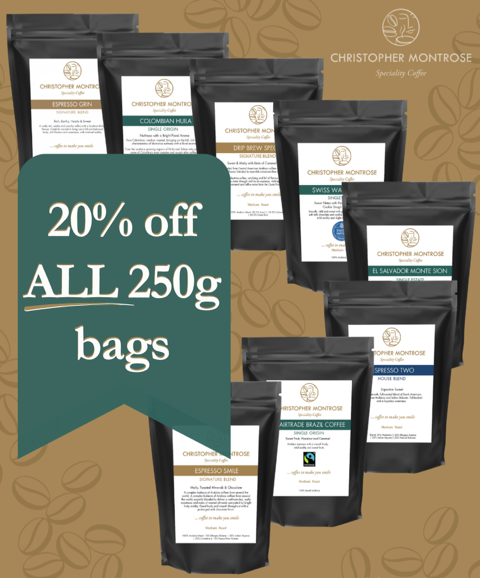
Our Drip Brew Special was created specifically as a filter coffee. It’s a third each Brazil, Colombia and Costa Rica, blended to resemble Jamaican Blue Mountain: sweet and malty black, and a splash of milk brings out caramel and toffee. For a single origin, Colombian Huila is full and rich but delicate, and makes a lovely V60 at breakfast or with an afternoon slice of cake. If you want filter in the evening, our Swiss Water Decaf works well, with roasted peanut and milk chocolate notes and a medium body. You can see everything we recommend for this style in our filter and cafetière collection, available as whole bean or ground for filter.
Not per sip. Espresso is far more concentrated. A typical mug of filter does tend to contain a little more caffeine in total than a single espresso, because the serving is so much larger.
Broadly, yes. “Drip coffee” usually means coffee from an electric filter machine, while “filter” covers both machines and hand pour over.
Yes, though a cafetière works best with a slightly coarser grind than a paper filter. Pre-ground “filter” coffee will work but may leave more sediment in the cup.
It’s worth doing. Rinsing removes any papery taste and warms the brewer, and it only takes a few seconds.
It’s at its best for the first 30 minutes or so. In an insulated flask it holds up reasonably well for an hour or two; on a hotplate it goes downhill much faster.
If you’re new to filter, start simple: 60 g per litre, a medium grind and water just off the boil, with a bag of Drip Brew Special. Get that right and every other method is just a variation.