Spend a further £18.00 for free delivery
Free delivery on orders over £18. Shop Now.
Free delivery on orders over £18
An americano is espresso topped up with hot water, giving a drink the size of a mug of filter coffee with the flavour of espresso. The popular story is that it was named after American soldiers in Italy during the Second World War, who found the local espresso too strong and diluted it to taste more like the coffee they knew at home. It’s a good story, and quite possibly true, but the history is a little less tidy than that.
You can’t have an americano without espresso, and espresso is an Italian invention of the turn of the 20th century. Angelo Moriondo of Turin patented an early steam-driven coffee machine in 1884. Luigi Bezzera and Desiderio Pavoni developed the idea into a machine that could make a single cup quickly to order, and showed it at the Milan Fair in 1906. The point was speed: coffee brewed in moments for customers at the bar, which is where the word “espresso” comes from.
American soldiers have had a famously close relationship with coffee since at least the Civil War. In the First World War, soluble (instant) coffee became part of the rations issued to US troops, because it was so much easier to prepare in the field than ground coffee. By the Second World War, the US Army was buying, roasting and shipping coffee to troops overseas on an enormous scale.
Those troops were used to large cups of mild, filter-style coffee. When the Allies moved through Italy from 1943, they met espresso: small, strong and drunk in a couple of mouthfuls. The story goes that GIs asked for hot water to stretch the shot into something closer to their usual brew, and Italian baristas began to call this a caffè americano.
The wartime story is widely told but hard to prove. The Oxford English Dictionary traces “café americano” to Central American Spanish in the mid-1950s, as a slightly mocking term for weak coffee, and the earliest English use it records is from 1964 (Caffè americano, Wikipedia). The Italian term seems to have caught on later. It’s quite possible the drink existed in Italian bars before the name was settled. Either way, the idea behind it’s the same: an espresso made long enough for people who like a bigger cup.
From Italy it spread across Europe and then the world, helped enormously by the coffee chains of the 1990s and 2000s.
An americano is simple, but the ratio and the water temperature make a real difference.
A common starting point is one part espresso to three or four parts water. In practice that means:
Use less water for something punchier, more for something gentler. If it tastes thin, add a shot rather than cutting the water right back.
This is where opinions differ. Pouring the espresso onto hot water keeps much of the crema on the surface and gives a slightly smoother, rounder first sip. Pouring water onto the espresso breaks the crema up and mixes the drink more evenly, which some people prefer. Some baristas prefer water first, and it’s the defining feature of a long black. Neither is wrong. Try both with the same coffee and see which you like.
All three are larger black coffees, but they are made quite differently.
| Americano | Long black | Filter coffee | |
|---|---|---|---|
| How it’s made | Espresso plus hot water | Hot water first, espresso poured on top | Hot water dripped through ground coffee and a filter |
| Typical size | 200 to 350 ml | Smaller, often 120 to 180 ml | 200 to 350 ml |
| Crema | Some, often broken up | Kept on top | None |
| Strength | Medium | Stronger, less water | Medium |
| Flavour | Espresso character, body and roast notes | Similar but more intense | Cleaner and lighter, more clarity |
| Where it’s common | Worldwide | Australia and New Zealand | Worldwide, especially speciality cafés |
An americano tastes different from filter coffee even at the same strength, because espresso extracts the coffee under pressure and brings out more body, oils and roast character. Filter is lighter and clearer. If that cleaner style appeals, our guide to filter coffee explains how to brew it.
There’s also the lungo, an espresso pulled long through the coffee rather than diluted afterwards. It tastes quite different again, as we explain in ristretto vs lungo.
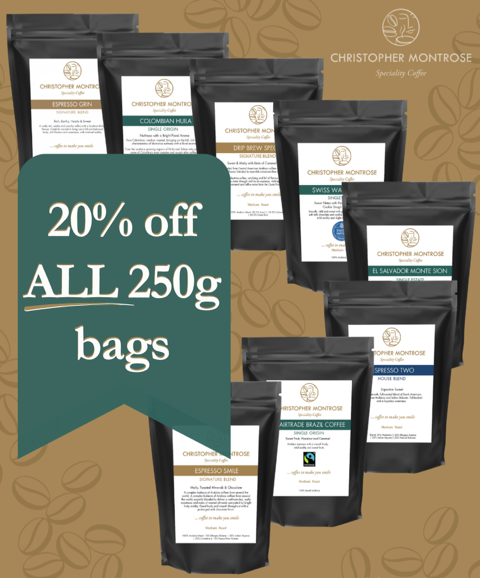
Because an americano is mostly water, it shows up the espresso clearly. A blend with good body and sweetness will hold up; a very sharp, light roast can taste thin once diluted. Our three espresso-friendly coffees each make a different americano:
The same as the espresso in it, as water adds none. Figures used by EFSA put a single espresso at around 80 mg (EUFIC, citing EFSA 2015), so a double-shot americano will be noticeably higher, though it varies with the coffee and the dose.
Not necessarily. A double-shot americano and a mug of filter can have similar caffeine. The americano usually tastes bolder because of the espresso’s body and roast character.
You can get close with a moka pot or a strong Aeropress topped up with hot water. It won’t be quite the same, as neither reaches espresso pressure, but it makes a very decent cup.
Caffè americano. You may get either espresso with hot water or a jug of filter-style coffee, so it’s worth checking. It’s not a traditional Italian order, so you will mostly see it in places used to visitors.
If you’re making americanos at home, start with a double shot of Espresso Grin and about 150 ml of hot water, then adjust from there. It’s the easiest way to see why a drink invented to tone espresso down has stayed so popular.