Spend a further £18.00 for free delivery
Free delivery on orders over £18. Shop Now.
Free delivery on orders over £18
Jamaica Blue Mountain is an arabica coffee grown only in a legally defined part of Jamaica’s Blue Mountains, between Kingston and Port Antonio. It’s famous for a mild, clean, sweet cup with very little bitterness, and it’s one of the most expensive coffees in the world. If you love that style but not the price, our Drip Brew Special was blended specifically to resemble it.
This guide covers where Blue Mountain coffee comes from, why it costs so much, what it tastes like, and how to get a similar cup for a fraction of the cost.
Coffee arrived in Jamaica in 1728, and the Blue Mountain coffee grown today is mainly from the Typica variety, an arabica that traces its roots back to Ethiopia (Wikipedia). What makes it “Blue Mountain” isn’t the plant but the place, and the rules that govern it.
Under regulations made under Jamaica’s Coffee Industry Regulation Act, coffee can only be called Blue Mountain if it’s grown in the parishes of St Andrew, St Thomas, Portland or St Mary, at between 3,000 and 5,500 feet (roughly 910 to 1,680 metres) (WIPO). Coffee grown elsewhere in Jamaica at lower altitudes is sold as Jamaica High Mountain or Jamaica Supreme instead.
The name is protected as a certification mark in the UK, the EU and the United States, and is regulated by the Jamaica Agricultural Commodities Regulatory Authority (JACRA), formerly the Coffee Industry Board. Green coffee is inspected before export, and only approved lots carry the Blue Mountain seal (Barista Magazine). It’s also traditionally shipped in wooden barrels instead of the usual jute sacks.
Several things push the price up at once.
Japan’s relationship with Blue Mountain coffee goes back decades. On 9 January 1967, around 60% of that year’s harvest was shipped from Kingston to Japan, and Japan remains the largest buyer today. In 2018 Japan recognised 9 January as Jamaica Blue Mountain Coffee Day (Wikipedia).
Estimates of Japan’s share vary from year to year, but it’s commonly put at somewhere between 70% and more than 80% of exports. That leaves relatively little genuine Blue Mountain for the UK and Europe, which is one reason it’s so expensive here and why “Blue Mountain style” and “Blue Mountain blend” coffees are common. A blend may contain only a small proportion of the real thing, so read the label carefully.
At its best, Blue Mountain is mild, smooth and clean, with a gentle sweetness, a medium body and soft, well-balanced acidity. The thing people mention most is what is missing: bitterness. It’s not a punchy or exotic coffee. Its appeal is balance, and that makes it easy to drink black.
Not everyone thinks it lives up to the reputation. Quality varies between estates and harvests, and some drinkers find it a little understated for the price. As with any coffee, freshness after roasting matters as much as origin.
Jamaican coffee has also long been associated with Tia Maria, the coffee liqueur. Its romantic origin story, about a servant who saved a family recipe while fleeing Jamaica in the 17th century, is a good tale, though some believe it was invented by marketers.
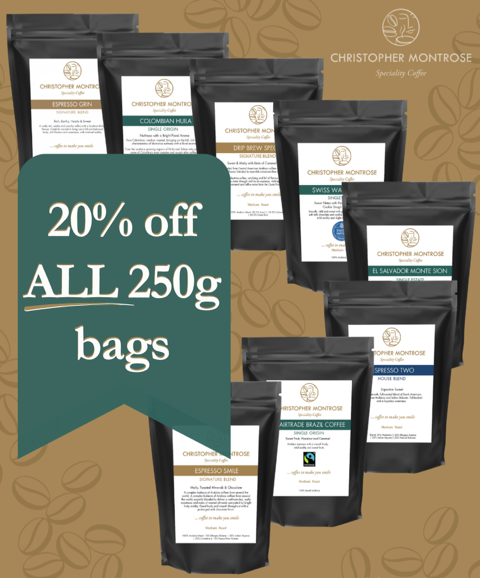
Chris and Monty created Drip Brew Special when they were looking for a filter coffee that could rival the flavour profile of Jamaica Blue Mountain, without its price. The challenge was to find beans that would give a similar experience in the cup: smooth, sweet, mild and low in bitterness.
The answer was a blend of three 100% Arabica coffees in equal parts:
| Origin | Share | What it brings |
|---|---|---|
| Brazil | One third | Body, nutty sweetness and a soft, low-acid base |
| Colombia | One third | Roundness, caramel sweetness and balance |
| Costa Rica | One third | Clean, bright lift that keeps the cup from tasting heavy |
The result is sweet and malty, with a smooth, gentle profile. Add milk and caramel and toffee notes come forward. Many of our customers tell us they prefer it to Blue Mountain. We would simply say it’s the closest thing in our range, and it costs a fraction as much.
A good blend brings together beans from different origins so that each covers what the others lack. Brazil on its own can be a little flat, Costa Rica on its own a little sharp; together with Colombia they make a balanced, consistent cup. Blending also lets us keep the flavour dependable from bag to bag, which is exactly what you want from an everyday filter coffee.
It’s also how we work in general. Over years of travelling and more than 5,500 tastings with farms, exporters, importers, roasters and baristas, Chris and Monty chose fewer than ten coffees for our range. Drip Brew Special earned its place as our answer to a very particular question.
Despite the name, it’s not fussy. It was created as a filter coffee, so it shines in a pour-over, filter machine or cafetière. Start with around 60g of coffee per litre of water, using water just off the boil (around 93 to 96°C). If you’re deciding between methods, our comparison of pour-over and drip brew will help, and our filter coffee guide goes into more detail.
It also makes a very respectable espresso, with the caramel notes coming through nicely in a flat white.
It depends what you value. It’s a fine, very smooth coffee, but a good part of the price reflects scarcity and reputation. If smoothness and low bitterness are what you are after, well-chosen blends get you remarkably close.
Look for “100% Jamaica Blue Mountain” and the official certification mark. Be wary of “Blue Mountain blend” or “Blue Mountain style”, which may contain little or none of it.
No. It’s known for being mild and smooth. If you prefer something bolder, our strong coffee range is a better fit.
Altitude and location. High Mountain is grown outside the defined Blue Mountain area at lower elevations, and is usually much cheaper.
If you have been paying Blue Mountain prices for your weekend coffee, try a bag of Drip Brew Special through a pour-over, black, and judge for yourself. It was made for exactly that cup.