Spend a further £18.00 for free delivery
Free delivery on orders over £18. Shop Now.
Free delivery on orders over £18
Arabica and robusta are the two coffee species that supply almost all the coffee in the world. Arabica is sweeter, more aromatic and more acidic, with roughly half the caffeine of robusta. Robusta is hardier, cheaper to grow and stronger, with a heavier, more bitter taste. Arabica makes up the larger share of world production, though robusta’s share has grown to roughly 40% or more in recent years.
Both have their place, and this guide explains how they differ and why every one of our blends is 100% arabica.
Arabica is Coffea arabica. Robusta is the common name for Coffea canephora, a separate species. They are as different, botanically, as two kinds of plum.
Arabica originated in the highland forests of Ethiopia and South Sudan, and it’s genetically unusual: it has four sets of chromosomes rather than two and can pollinate itself. That partly explains why it varies less in the wild and is more vulnerable to disease. Robusta grows naturally across central and western Africa, from Liberia to Tanzania and south to Angola. It needs pollen from another plant to set fruit, which gives it more genetic diversity and more resilience.
| Arabica | Robusta | |
|---|---|---|
| Species | Coffea arabica | Coffea canephora |
| Caffeine (green bean, by weight) | Roughly 1.2 to 1.5% | Roughly 2.2 to 2.7% |
| Sugars (sucrose) | About 6 to 9% | About 3 to 7% |
| Oils (lipids) | About 15 to 17% | About 10 to 11% |
| Typical altitude | About 600 to 2,200m | About 0 to 800m |
| Climate | Cool and stable, mean around 19°C | Hot and humid, copes with irregular rain |
| Disease resistance | Lower | Higher |
| Flavour | Sweeter, brighter, more aromatic | Earthy, woody, bitter, heavier |
| Bean shape | Oval, curved centre line | Rounder, straighter centre line |
The composition figures are from Compound Interest, and individual studies vary a little, but the pattern is consistent. The higher sugar and oil content in arabica is a big part of why it tastes sweeter and smoother.
Robusta has roughly double the caffeine of arabica, around 2.2 to 2.7% of the bean’s weight compared with 1.2 to 1.5%. Caffeine is bitter, and it’s also a natural defence against insects, which helps explain why robusta copes better with pests.
If you want a stronger kick, a robusta blend will give you more caffeine per cup. If you’re watching your intake, the European Food Safety Authority considers up to 400mg of caffeine a day safe for healthy adults, and the NHS advises no more than 200mg a day in pregnancy. This isn’t medical advice; if you have a health condition or are pregnant, check with your GP.
Good arabica is smoother and sweeter, with flavour notes running from chocolate and caramel to fruit, citrus and flowers. It has more acidity, which, done well, tastes lively rather than sour. Arabica is generally held to be the higher quality species, and almost all speciality coffee is arabica.
The plants are fairly small and easy to prune, but they are sensitive to their surroundings. Altitude, soil, rainfall and temperature all show up in the cup, which is why we wrote a whole article on why altitude matters.
Most arabica varieties trace back to two old lineages, Typica and Bourbon, and much of the difference between them comes down to flavour and character.
Typica is one of the oldest cultivated varieties and the one that carried coffee from Yemen to Java and on to the Americas, which is why it’s regarded as the original coffee of the New World. It’s low yielding but valued for its excellent cup quality.
Bourbon is named after the Indian Ocean island of Bourbon, now Réunion, where it developed. It’s prized for its sweet, complex and balanced flavour, and it has given rise to many high-quality mutations and offshoots, including Caturra, which grows in our Colombian Huila.
Arabica from different countries has distinct characteristics. Kona coffee, for example, comes from the Kona district of Hawaii’s Big Island, where the volcanic soil and climate give it a character you won’t find elsewhere.
While we’re on the subject, Mocha has become shorthand for a chocolatey coffee drink, roughly a cross between a cappuccino and a hot chocolate. Originally, though, Mocha (or Mokha) was the port in Yemen through which arabica was exported for centuries, and the name was given to the coffee shipped from there.
Robusta is the second most produced species in the world. It grows best in hot climates with irregular rainfall, and the plants are hardier and more disease resistant than arabica. Vietnam, where French colonists introduced it in the late 19th century, is now the world’s largest robusta exporter, and Brazil grows a lot too.
In the cup, robusta tends to be earthy, woody and bitter, with less acidity and a heavier body. Cheap robusta can taste harsh or rubbery. That’s why it’s generally considered inferior, and why it dominates instant coffee and supermarket blends where price matters most.
It isn’t all bad news. Well-grown, carefully processed robusta can be pleasantly chocolatey, and it has a traditional role in Italian espresso blends, where it is known for producing a thicker crema, the creamy layer on top of a shot, and a heavier body. There’s a growing interest in fine robusta among speciality roasters too.
A third species, Coffea liberica, accounts for a tiny share of world production. It has large, irregular beans and a bold, smoky, sometimes fruity flavour, and it’s grown mainly in Malaysia, the Philippines and parts of Indonesia.
Excelsa used to be counted as a separate species. Botanists now mostly treat it as a variety of liberica (Coffea liberica var. dewevrei), as the Global Coffee Report explains. It’s known for tart, fruity flavours and is sometimes used to add depth to blends.
With climate change squeezing the land where arabica grows well, these lesser-known species, and wild ones such as stenophylla, are attracting attention from researchers. We cover that in our article on making the coffee industry more sustainable.
We have tasted a lot of coffee, more than 5,500 tastings across farms, exporters, importers, roasters and baristas, and we keep coming back to arabica for its sweetness, aroma and range of flavour.
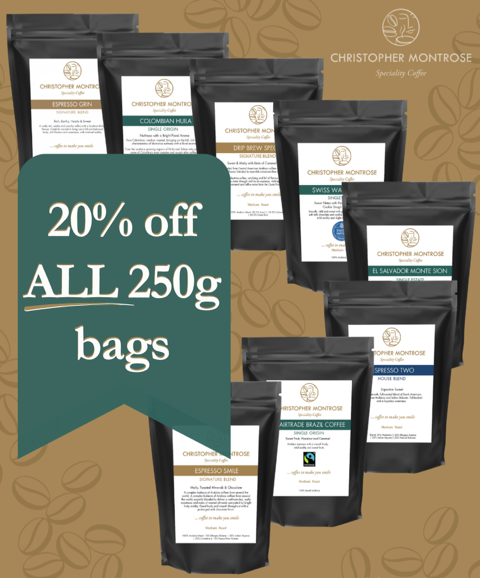
Choosing arabica doesn’t mean giving up body or punch. Our Espresso Grin is a medium-dark, Italian-style blend of Brazil, Colombia, Guatemala and Sumatra: rich, earthy and full bodied with low acidity, the sort of thing people often expect to contain robusta. At the lighter end, Espresso Smile brings malty sweetness, toasted almonds and bright fruity acidity.
Robusta, on both counts. It has around twice the caffeine and a heavier, more bitter taste.
Not automatically. Poor arabica can taste flat or sour, and good robusta can make a decent espresso. On average, though, arabica gives a sweeter, more interesting cup.
It grows at lower altitudes, yields more, resists pests and disease better and is easier to farm, so it costs less to produce.
It tends to produce a thicker, longer-lasting crema, which is one reason it appears in traditional Italian blends. Crema looks good but isn’t a reliable sign of flavour.
If you’d like to taste what arabica can do in espresso, our Espresso Explorer starter kit pairs Grin and Smile, so you can try a bold blend and a brighter one side by side.